
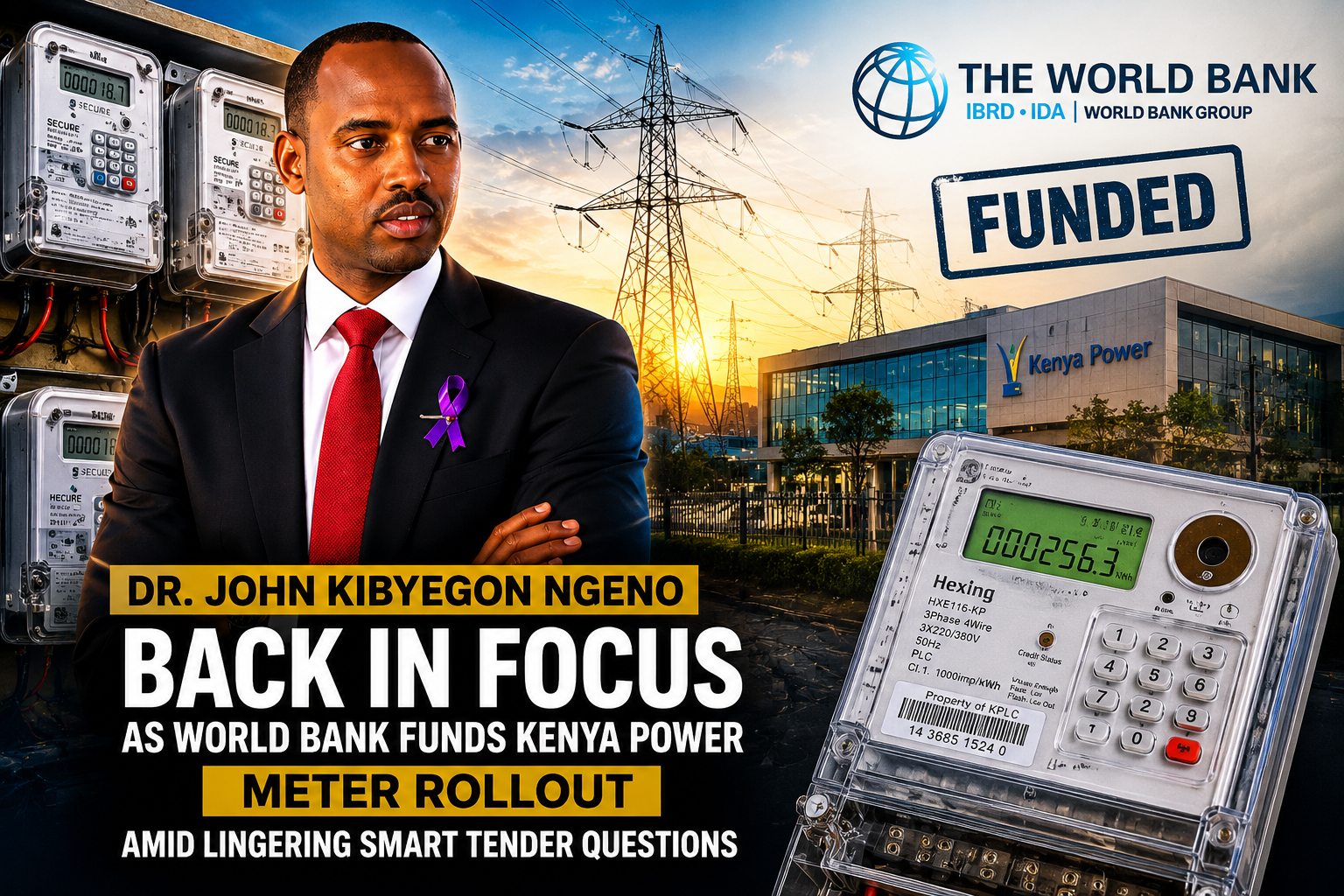
Dr John Kibyegon Ng’eno is once again under the spotlight as Kenya Power and Lighting Company embarks on a new World Bank-funded prepaid meter rollout—an initiative meant to modernise the country’s electricity system but one that arrives against the backdrop of unresolved concerns tied to a previous multibillion-shilling smart meter procurement associated with his tenure in supply chain leadership.
The new rollout, backed by the World Bank, forms part of the Kenya Off-Grid Solar Access Project (KOSAP).
The program is designed to expand electricity access in underserved counties such as Turkana, Garissa, and Kilifi through mini-grids, solar systems, and prepaid metering infrastructure.
A procurement notice issued in May 2026 confirms that funds will be used to supply single-phase prepaid meters and miniature circuit breakers, with bidding open under international competitive standards.
On paper, the initiative represents a critical intervention in Kenya’s energy sector. Prepaid meters are widely seen as a solution to long-standing issues such as billing disputes, electricity theft, and revenue leakage.
They also offer consumers greater control over electricity usage and expenditure.
However, the significance of this new investment cannot be separated from the procurement history that precedes it.
The Smart Meter Tender That Refuses to Fade
In recent years, Kenya Power awarded contracts estimated at Sh20–21 billion for the supply of smart meters across four separate packages. The beneficiaries included:
- Inhemeter Africa Company Ltd (linked to William Kabinga Gatheca)
- Smart Meter Technology Ltd (associated with Sam Mburu, husband to Nakuru Governor Susan Kihika)
- Yocean Group Limited
- Magnate Ventures Ltd (linked to Stanley Kinyanjui and associates)
The procurement process was challenged by businessman Benedict Kabugi Ndungu, who filed a complaint with the Public Procurement Administrative Review Board.
His petition alleged that the tender framework had been significantly altered through a series of addenda, shifting eligibility criteria away from established local manufacturers toward firms operating as assemblers or intermediaries.
While amendments to procurement documents can be legitimate when justified, the scale and timing of these changes raised concerns about whether the process remained aligned with its original intent.
Questions Around Process Integrity
Beyond eligibility criteria, scrutiny extended to how the procurement process was managed internally. Reports indicated that standard review procedures—typically involving procurement officers and technical evaluation teams—may not have been followed in full.
Instead, decision-making authority was reportedly concentrated at higher levels within the organization, including the office led by Dr. Ngeno at the time.
Such deviations, if substantiated, would represent a shift from established procurement safeguards designed to ensure transparency and accountability.
They also highlight the importance of maintaining clear documentation and adherence to internal controls in large-scale public procurements.
Pricing disparities further intensified scrutiny. Reports suggested that the awarded contracts priced smart meters at levels significantly higher than comparable market offerings.
While variations in specifications and service terms can justify price differences, substantial gaps require detailed justification to confirm value for money.
Oversight Bodies and Unresolved Outcomes
The matter was escalated to key oversight institutions, including the Directorate of Criminal Investigations, the Office of the Director of Public Prosecutions, and the Ethics and Anti-Corruption Commission.
While the case attracted significant public and parliamentary attention, there has been no widely reported conclusive outcome or prosecution directly linked to the tender. As a result, the issue remains part of ongoing public discourse rather than a fully settled matter.
From KEBS to Kenya Power: A Career Under Scrutiny
Dr. Ngeno’s role in procurement has drawn attention beyond Kenya Power. Prior to his appointment in 2020, he served at the Kenya Bureau of Standards, where the institution faced several high-profile controversies, including issues related to product quality oversight and procurement practices.
Although these matters involved broader institutional frameworks, they contributed to a pattern of scrutiny surrounding procurement governance in agencies handling large public budgets. His transition to Kenya Power placed him at the center of one of the country’s most financially significant procurement environments.
A New Procurement, Familiar Expectations
The ongoing prepaid meter rollout under KOSAP is structured within the safeguards typical of donor-funded projects. These include competitive bidding, defined procurement rules, and oversight mechanisms intended to ensure compliance and transparency.
Even so, the historical context has heightened expectations around the process.
Key areas now under close observation include:
- Consistency of tender requirements throughout the procurement cycle
- Adherence to established evaluation procedures
- Alignment of pricing with market benchmarks
- Verification of supplier capacity and technical qualifications
These are standard considerations in any audit framework, but their importance is amplified in light of previous experiences.
Why This Moment Matters
Kenya Power continues to face operational and financial challenges, including system losses, legacy debts, and public dissatisfaction over billing and service reliability. The prepaid meter rollout is intended to address some of these issues by improving revenue collection and reducing inefficiencies.
For communities in underserved counties, the project could significantly improve access to electricity and support economic activity.
However, the effectiveness of such initiatives depends not only on their technical design but also on the credibility of the processes through which they are implemented.
Balancing Reform and Confidence
The coexistence of a new World Bank-backed initiative and unresolved questions from a previous procurement highlights a broader challenge in public sector management: ensuring that reforms are accompanied by accountability.
Donor-funded projects often come with heightened expectations for transparency and compliance. Maintaining these standards is essential not only for project success but also for sustaining partnerships with international institutions.
Oversight bodies, including the Ethics and Anti-Corruption Commission, the Directorate of Criminal Investigations, and procurement regulators, remain central to this process, providing checks that reinforce institutional integrity.
Conclusion
The prepaid meter rollout supported by the World Bank represents a significant opportunity to modernize Kenya’s electricity infrastructure and expand access to energy.
At the same time, the lingering questions surrounding the earlier smart meter tender continue to shape public perception and scrutiny of procurement practices within Kenya Power and Lighting Company.
For Dr. John Kibyegon Ng’eno and the institution he has served, the moment underscores the importance of transparency, adherence to procedure, and clear documentation.
In a sector where public resources and national development intersect, the expectation is not only delivery—but delivery that meets the highest standards of accountability.