
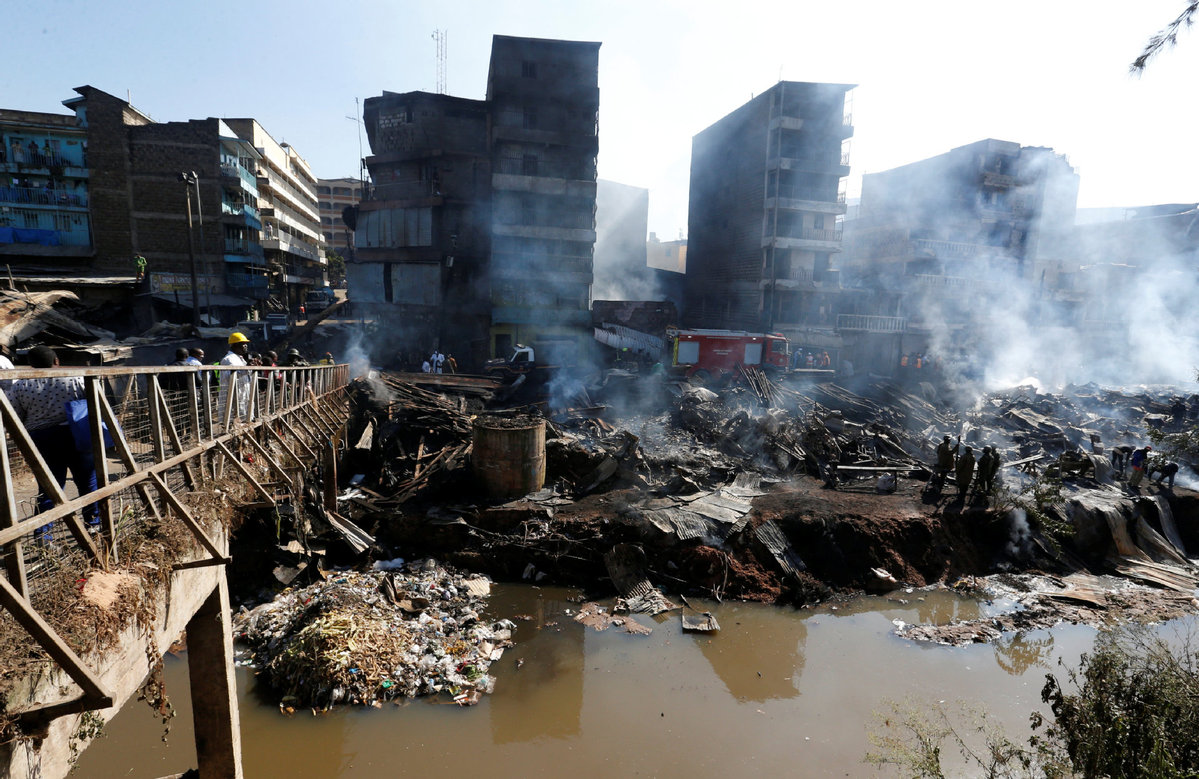
The recent demolition at Gikomba Market has ignited a heated national conversation, after hundreds of traders were left jobless following a government-led clearance aimed at enforcing a 30-meter riparian buffer along the Nairobi River.
What was framed as an environmental and urban planning intervention has quickly evolved into a deeply emotional and political issue, touching on livelihoods, trust in government, and the delicate balance between development and economic survival.
For decades, Gikomba has been one of Nairobi’s busiest informal markets, supporting thousands of traders dealing in second-hand clothes, textiles, and household goods. It is more than just a marketplace—it is an economic lifeline for families who rely on daily earnings to survive. The demolition, therefore, has not only removed physical structures but also disrupted entire livelihoods overnight.
The government’s position is rooted in environmental protection and urban order. Authorities have emphasized the need to reclaim riparian land to prevent flooding, reduce pollution, and restore the ecological integrity of the Nairobi River. These goals are widely acknowledged as necessary, especially given the recurring challenges of flooding and poor sanitation in the city.
However, the manner and timing of the demolition have drawn criticism. Many argue that while the intention may be justified, the execution lacked adequate public sensitisation and planning. Traders claim they were either not properly informed or were given insufficient time to prepare for relocation, leaving them vulnerable and economically exposed.
At the center of the response is William Ruto, who has defended the move while also outlining plans for a long-term solution. The President stated that the government is working on designing a modern national market at Gikomba, with an estimated investment of KSh 5 billion. According to him, the new facility aims to transform Nairobi into a more orderly, functional, and globally competitive capital.
President William Ruto: I was in Gikomba, and we are now designing a modern national market. I have given my undertaking that we are going to build a 5-billion-shilling modern market in Gikomba. This will strengthen Nairobi’s standing as a capital worthy of the republic it… pic.twitter.com/ph7rcnWRhD
— Citizen TV Kenya (@citizentvkenya) February 17, 2026
While this promise offers hope, many affected traders remain skeptical. For those who depend on daily income, future infrastructure projects do little to address immediate needs. The gap between displacement and redevelopment is where the real crisis lies, as traders struggle to find alternative spaces and sources of income.
Beyond the economic impact, the demolition has also taken on a political dimension. Gikomba has long been associated with a strong base of traders from Central Kenya, particularly the Kikuyu community. As a result, the move is being interpreted by some through a political lens, with concerns that it could alienate a key voting bloc.
Critics argue that such a significant intervention should have been handled with greater political sensitivity. There are comparisons being drawn to actions taken during the tenure of Uhuru Kenyatta, particularly in areas like Nyamakima, where similar demolitions reportedly left lasting political resentment among affected communities.
The argument being raised is not necessarily against development or enforcement of regulations, but rather about timing and approach. Some observers suggest that such disruptive reforms are often better implemented with comprehensive stakeholder engagement, clear communication, and, in some cases, strategic timing within the political cycle.
There is also a growing call for structured resettlement plans. Urban planning experts emphasize that successful enforcement of environmental regulations must go hand in hand with social safeguards. This includes identifying alternative trading spaces, providing transitional support, and ensuring that affected populations are not pushed further into poverty.
At the same time, others maintain that delaying such actions only perpetuates long-term risks. Encroachment on riparian land has contributed to flooding, loss of life, and environmental degradation. From this perspective, decisive action is necessary, even if it comes with short-term consequences.
The situation at Gikomba highlights a broader challenge facing rapidly growing cities like Nairobi: how to modernize infrastructure and enforce regulations without undermining informal economies that support a large portion of the population.
As discussions continue, one key lesson emerging is the importance of communication. Public sensitisation—clearly explaining why such actions are necessary, what alternatives exist, and how affected individuals will be supported—can significantly reduce resistance and build trust.
For now, the future of Gikomba remains uncertain. The promise of a modern market offers a vision of progress, but its success will depend on how inclusively and transparently it is implemented.
Ultimately, the demolition has become more than just an urban planning exercise. It is a test of governance—how to balance environmental responsibility, economic survival, and political realities in a way that leaves no one behind.