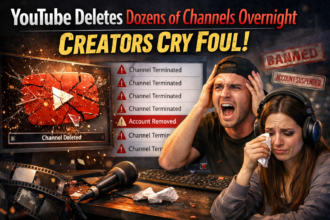
A growing wave of concern is sweeping through the creator community after multiple animation channels were suddenly removed from YouTube, with affected users claiming the platform’s enforcement systems are misfiring at scale.
Over the past few days, several animators have reported that their channels were taken down under violations related to “spam, fraud, and deception policies”—a classification they strongly dispute.
According to the affected creators, their content consists of original animations, including hand-crafted characters, storytelling, editing, and production done entirely by the channel owners themselves.
They insist there is no automation, no misleading practices, and no form of spam typically associated with policy violations.
Despite this, entire channels—some built over years—have reportedly disappeared without prior warnings or strikes.
What has made the situation even more alarming is what happens after appeals.
In several reported cases, creators say their channels were successfully restored following an appeal—suggesting that a human review may have confirmed no wrongdoing.
However, shortly after being reinstated, some of these same channels were taken down again, allegedly by automated systems.
This cycle—removal, restoration, and removal again—has fueled fears that there may be a deeper systemic issue within YouTube’s moderation infrastructure.
Creators describe the experience as chaotic and unpredictable, where even successful appeals do not guarantee long-term resolution.
Adding to the frustration is the nature of responses from support teams.
Many affected users report receiving generic replies stating that the decision is final, even in cases where contradictory actions—such as reinstatement followed by removal—have already occurred.
This has led to accusations that the platform’s enforcement process lacks consistency, transparency, and accountability.
Several animation creators, including accounts like @CCountryz18217, @FairyLabYT, @stategirlsyou, @BoomLab172561, and @SOKALUPEC, have been cited among those affected, though the full scale of the issue may be much larger.
The situation is particularly concerning for animators, whose work often requires significant time, skill, and resources to produce, making sudden channel deletion especially devastating.
Industry observers point to YouTube’s increasing reliance on automated moderation systems as a possible factor.
With billions of videos and channels to monitor, the platform uses artificial intelligence to detect policy violations—but critics argue that these systems may struggle to accurately interpret creative or niche content like animation.
False positives—where legitimate content is flagged incorrectly—are not new, but the apparent volume and pattern of these removals suggest a potential escalation.
Some experts believe the issue could be tied to broader efforts by YouTube to crack down on low-quality or mass-produced content, particularly in categories that have been abused by spam networks in the past.
However, this approach may be unintentionally sweeping up legitimate creators in the process.
The controversy also highlights a deeper challenge facing digital platforms: balancing large-scale moderation with fairness and precision.
While automated systems are essential for managing vast amounts of content, they can lack the contextual understanding needed to distinguish between harmful material and genuine creative work.
For creators, the stakes are high.
A YouTube channel is not just a platform—it is often a source of income, a portfolio, and a personal brand built over years.
Losing it overnight, without clear explanation or reliable recourse, can have serious financial and emotional consequences.
As pressure mounts, creators are now calling on YouTube and its support teams to address the issue publicly, review affected cases, and improve the appeal process.
Many are also demanding greater transparency in how decisions are made, especially when automated systems are involved.
For now, the situation remains unresolved, with more creators coming forward and raising similar concerns.
Whether this turns out to be a temporary glitch or a deeper systemic flaw, one thing is clear: trust between platforms and creators is being tested—and the outcome could shape the future of online content creation.