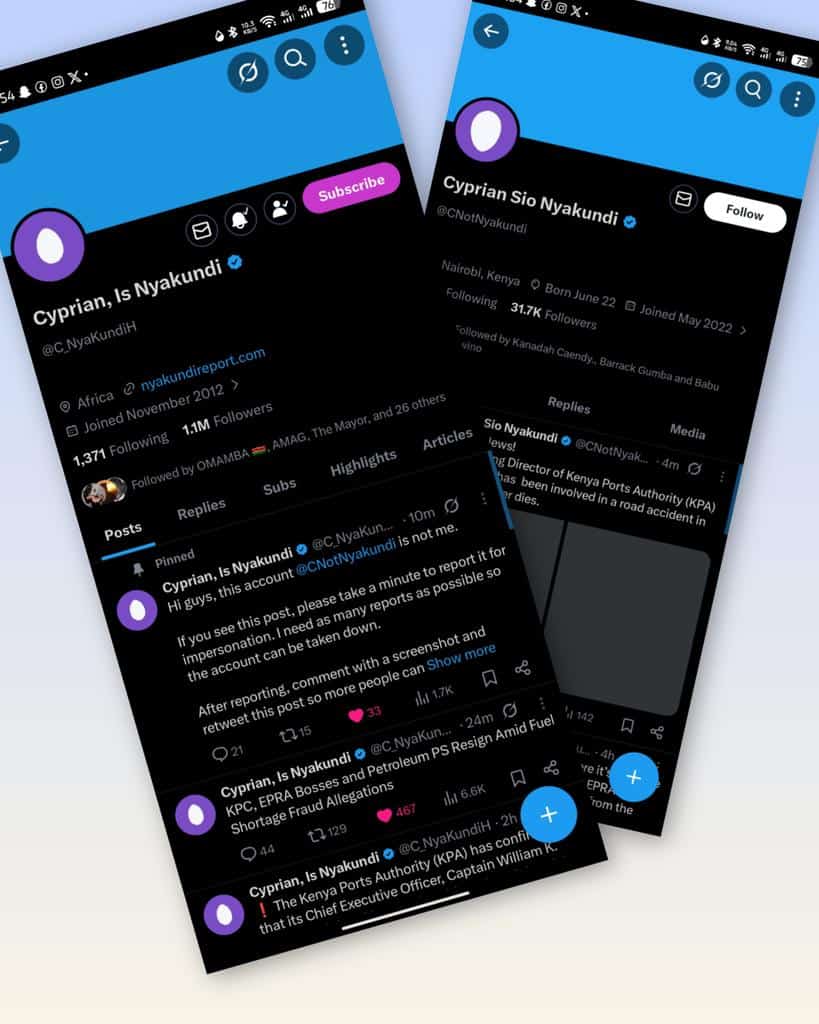
A growing online storm has erupted after more than 500 users reportedly flagged an account accused of impersonating controversial blogger Cyprian Nyakundi, highlighting rising concerns over identity misuse and misinformation on X.
The account, which operates under a slightly altered name “Cyprian, sio Nyakundi,” has triggered widespread confusion among users, many of whom initially believed it belonged to the well-known blogger.
Despite the account including a disclaimer stating it is not Nyakundi, several users argue that the similarity in name and style is misleading, especially at first glance.
Some users admitted they were briefly convinced the account was authentic, with one noting that the confusion was immediate before realizing the subtle distinction.
Others expressed concern that such accounts exploit familiarity and reputation to gain attention, influence conversations, or spread content under false assumptions.
Hi guys, this account @CNotNyakundi is not me.
If you see this post, please take a minute to report it for impersonation. I need as many reports as possible so the account can be taken down.
After reporting, comment with a screenshot and retweet this post so more people can…
— Cyprian, Is Nyakundi (@C_NyaKundiH) April 4, 2026
Within hours, calls to report the account intensified, with multiple users describing impersonation as a serious violation that should not be tolerated on the platform.
“Impersonation is a very grave mistake,” one user stated, echoing a sentiment shared across several posts demanding action.
Another user confirmed they had already reported the account after feeling misled earlier in the day, adding to the growing number of complaints.
However, not everyone agrees that the account crosses the line into harmful impersonation.
Some users argue that the disclaimer clearly distances the account from the real Nyakundi, suggesting that responsibility also lies with users to verify handles before engaging.
Others pointed out that even high-profile figures such as Elon Musk are frequently impersonated online, implying that such incidents are part of the broader social media landscape.
Still, critics insist that the issue is not just about disclaimers, but about the intent and effect of closely mimicking a recognisable identity.
They argue that even temporary confusion can mislead audiences, distort conversations, and potentially damage reputations.
The situation underscores a growing challenge for social media platforms, where impersonation accounts can quickly gain traction before being flagged or taken down.
It also highlights the thin line between parody, satire, and misleading representation, especially when accounts operate in a grey area that is not immediately obvious to all users.
As reports continue to rise, pressure is mounting on platform moderators to review the account and determine whether it violates impersonation policies.
The incident has reignited debate about digital identity protection, verification systems, and how platforms should handle accounts that blur the line between imitation and deception.
For now, the account remains a subject of intense scrutiny, with users divided between those calling for its removal and those defending its right to exist under clearly stated disclaimers.
What is clear, however, is that the digital space is becoming increasingly sensitive to issues of identity and authenticity, as users demand greater accountability and transparency online.