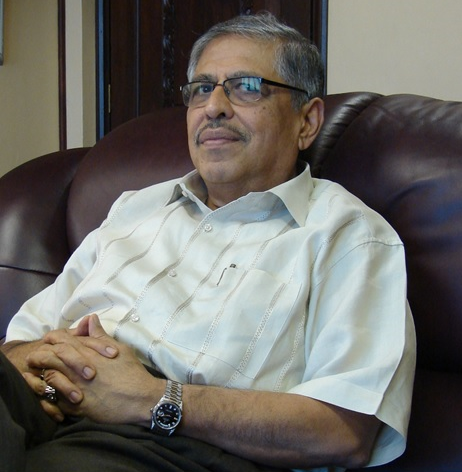
The name Mohamed Husein Abdulla Jaffer has once again resurfaced at the center of Kenya’s latest petroleum supply chain controversy, reinforcing a long-standing pattern where the veteran businessman repeatedly appears in high-stakes economic and political disputes.
Jaffer, a Mombasa-born tycoon, is not a newcomer to influence.
Born in 1948, he built a vast business empire over decades, rising from modest beginnings to become one of Kenya’s most powerful private sector figures with deep roots in logistics, energy, and port operations.
His business footprint spans cargo handling, bulk storage, and infrastructure tied closely to Kenya’s import-export economy—sectors that are not only lucrative but also deeply intertwined with government policy and procurement systems.
Also Read: Explosive Letter Reveals CS Opiyo Wandayi Knew About Irregular Fuel Imports
This proximity to critical national infrastructure has often placed him in strategic positions where private enterprise meets public interest.
But it is precisely this intersection that has made his name a recurring feature in controversy.
Over the years, Jaffer has been linked—directly or indirectly—to disputes surrounding port operations, cargo handling monopolies, and politically sensitive contracts.
Reports have previously associated him with influential business circles benefiting from Container Freight Station (CFS) operations at the coast, alongside other powerful political figures.
He has also been connected to high-level political networks, with past claims suggesting that decisions at the top levels of government may have been influenced by relationships with key business actors like himself.
The documents, filed under the Companies Act, 2015 and updated as of early April 2026, outline not just ownership and management, but also significant financial obligations tied to both entities, raising fresh questions about their operational scale and role within the wider fuel supply ecosystem.
One Petroleum Limited emerges from the records as a Mombasa-based company incorporated on November 24, 2010, under registration number CPR/2010/36450.
The firm holds a nominal share capital of KSh 5.1 million, broken down into 5,100 ordinary shares with a value of KSh 1,000 each.
Its registered office is located in Mombasa at Plot No. Mombasa/Block XXIV/49 and 50, positioning it strategically within Kenya’s primary petroleum import and logistics corridor.
A closer examination of its financial filings reveals multiple encumbrances that collectively point to substantial borrowing and asset-backed financing.
Among these are a specific debenture dated September 2, 2024, securing USD 9,500,000, alongside a deed of assignment of receivables on the same date for an equivalent amount.
Further entries include an assignment of receivables dated July 5, 2024, valued at USD 3,000,000, matched by a specific debenture of the same amount and date.
An all-assets debenture dated December 5, 2025, secures USD 11,000,000, while another specific debenture dated May 8, 2025, accounts for USD 9,000,000.
Taken together, these financial instruments indicate that the company has leveraged tens of millions of dollars against its operations, suggesting either aggressive expansion or heavy dependence on structured financing.
The list of directors and shareholders further paints a picture of concentrated control within the company.
Those listed include Solomon Eswbe Mwanjumwa Ondege (Director), Nicholas Kokita (Secretary), Mutara Mohamed Jaffer (Director), Ali Abbas Jaffer (Director), Mohamed Husein Jaffer (Director), and Ali Salaah Balia (Director).
In addition, Mbaraki Holdings Limited appears as a shareholder, holding 41,098 ordinary shares, with its registration linked to Mauritius—introducing an offshore ownership element into the company’s structure.
The recurrence of the Jaffer name across multiple directorships suggests a tightly knit ownership circle, potentially indicating a family-controlled or closely aligned business network.
In contrast, Oryx Energies Kenya Limited presents a more globally integrated corporate profile.
The company was registered on March 27, 2003, and carries a nominal share capital of KSh 2 million divided into 1,000 shares valued at KSh 2,000 each.
Its registered office is situated in Westlands, Nairobi, at the junction of Ring Road Parklands and Lower Kabete Road—an address associated with major corporate operations.
The financial disclosures for Oryx indicate significantly larger capital commitments.
A security debenture dated May 8, 2023, secures USD 250,000,000, accompanied by a deed of assignment of receivables of the same value and date.
Another specific debenture dated December 3, 2025, is listed at USD 200,000,000, highlighting the company’s substantial financial capacity and access to large-scale funding.
The leadership structure reflects its international footprint.
Named in the records are Conrad Nyukuri (Secretary), Sidy Bane (Director), August Dominick Mrema (Director), and Herve Christophe Bouvet (Director).
The shareholder base includes Oryx Energies SA and Overseas Petroleum Holdings SA, both associated with Geneva, Switzerland, underscoring strong foreign ownership and global linkages.
The contrast between the two firms is striking.
While One Petroleum Limited appears to operate as a locally anchored entity with some offshore backing, Oryx Energies Kenya Limited is clearly part of a broader international corporate network with access to significantly larger financial resources.
Now, fresh scrutiny emerges from the ongoing fuel import scandal.
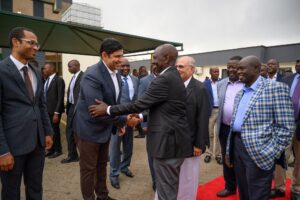
New company registry documents and petroleum supply chain investigations have highlighted networks of companies, offshore entities, and heavily leveraged financial structures operating within Kenya’s fuel ecosystem.
Among the names appearing in these corporate webs are individuals and entities linked to the broader Jaffer business network, raising questions about influence, control, and financial flows in the sector.
The current scandal revolves around allegations of irregular fuel imports, manipulation of supply data, and the possible entry of substandard petroleum products into the Kenyan market under the cover of emergency procurement frameworks.
Investigators are particularly interested in how certain companies—some with offshore connections and massive debt-backed financing—were positioned to benefit from these transactions.
This is where Jaffer’s long-standing presence in logistics and fuel-related infrastructure becomes significant.
Industry insiders argue that no major petroleum movement—whether through storage, shipping, or distribution—can occur at scale without intersecting with networks that have historically dominated Kenya’s port and bulk handling systems.
And for decades, Jaffer has been one of the most prominent figures in that space.
Critics say this concentration of influence creates an environment where a small circle of powerful actors can shape market dynamics, influence procurement outcomes, and benefit from regulatory gaps.
Supporters, however, argue that Jaffer represents a generation of entrepreneurs who built critical infrastructure when few others were willing or able to invest, and that his continued presence reflects experience rather than impropriety.
One of the most prominent areas where his name has repeatedly appeared is the National Youth Service (NYS) scandals, especially the widely publicized NYS II saga.
These scandals involved the loss of billions of public funds through fraudulent procurement schemes, including fake suppliers, inflated invoices, and collusive contracting networks that siphoned money from government programs meant to empower youth.
While Jaffer has not been conclusively convicted in connection with these cases, his name has surfaced in investigative trails, audit queries, and supplier linkages associated with companies that benefited from NYS tenders.
This pattern—where individuals are repeatedly mentioned in investigative contexts without resulting prosecutions—has become a defining feature of Kenya’s anti-corruption landscape.
Beyond NYS, Jaffer’s business networks have also been associated with broader allegations of procurement irregularities across government-linked sectors.
Critics argue that some of these networks exhibit characteristics commonly described as “state capture,” where a small circle of politically connected individuals gains disproportionate influence over public procurement systems.
Such influence, they claim, manifests through preferential awarding of contracts, limited transparency in tender processes, and the strategic positioning of companies to benefit from government spending.
Supporters, however, counter that large-scale infrastructure and logistics operations naturally attract scrutiny due to their size and complexity, and that involvement in major contracts does not automatically equate to wrongdoing.
Another key dimension of the controversy surrounding Jaffer is his perceived proximity to political power.
Over the years, he has been linked—formally or informally—to influential political figures, raising persistent concerns about whether such relationships could shield individuals from accountability or provide undue influence over government decisions.
Still, the pattern is difficult to ignore.
From port logistics disputes to fuel import controversies, his name repeatedly appears at moments when billions of shillings and national economic interests are at stake.
The resurfacing of his profile—highlighted even in global academic platforms such as Harvard Business School—underscores his stature as a major figure in emerging markets and African enterprise.
Yet it also amplifies the scrutiny that comes with such influence.
As Kenya’s petroleum investigation deepens, attention is no longer limited to individual officials or isolated transactions.
Instead, it is expanding toward understanding the networks—corporate, financial, and political—that underpin the entire supply chain.
In that broader picture, Mohamed Jaffer is not just a businessman.
He is a symbol of how power, capital, and state-linked industries intersect in Kenya.
And once again, he finds himself at the center of a storm that could redefine accountability in one of the country’s most critical sectors.