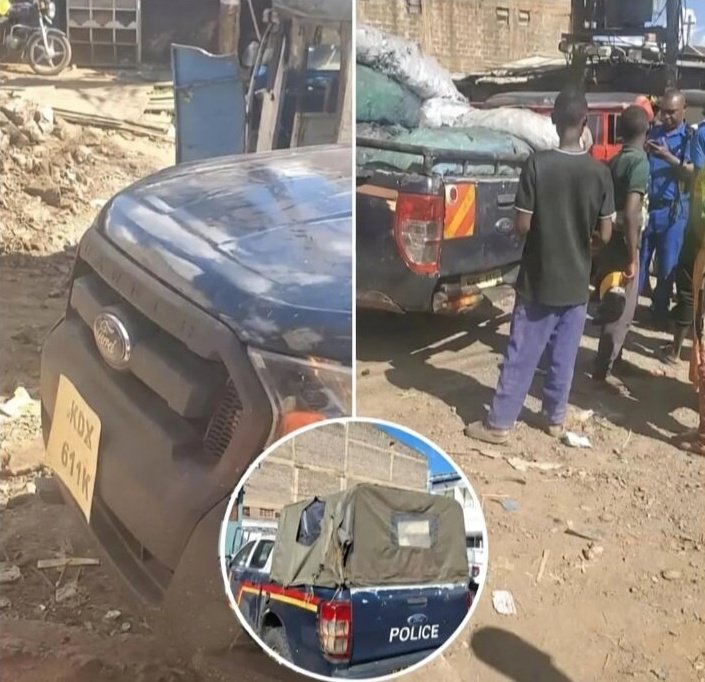
Residents of Githurai 44 were left stunned after police arrested a man accused of pulling off one of the most unusual vehicle theft schemes in recent memory—stealing a police car, disguising it, and using it for charcoal transport.
According to reports, the suspect allegedly gained access to a police vehicle before executing a bold plan to conceal its identity by removing the official number plates and replacing them with fake ones.
With the vehicle’s identity altered, the man is said to have repurposed the police car for commercial use, ferrying charcoal within the Githurai area without raising immediate suspicion.
The audacity of the act has sparked widespread reaction, with many Kenyans expressing disbelief at how a marked government vehicle could be stolen, modified, and used in plain sight.
Authorities eventually uncovered the scheme, leading to the suspect’s arrest and recovery of the vehicle.
Investigators are now working to establish how the individual managed to access and take control of the police car in the first place, raising serious questions about internal controls and security within law enforcement systems.
The use of fake license plates adds another layer of concern, as it points to deliberate intent to evade detection and operate the stolen vehicle over a period of time.
Security experts note that such actions could have posed a significant risk, as a vehicle resembling or formerly belonging to law enforcement could easily be used to bypass scrutiny or carry out other illegal activities.
Man Arrested in Githurai 44 for Stealing Police Car, Using It to Ferry Charcoal pic.twitter.com/NXVzP7ycEx
— Pulse Reels (@Pulse_Reels) April 9, 2026
The incident has also reignited public debate about accountability and safeguards within police operations, particularly regarding the handling and tracking of official vehicles.
Online reactions have ranged from humor to concern, with some Kenyans joking about the boldness of the act, while others questioned how such a breach could occur without immediate detection.
Despite the lighthearted reactions in some quarters, the case highlights deeper issues around security lapses, misuse of state resources, and the evolving nature of crime in urban areas.
Authorities are expected to pursue charges related to theft of a government vehicle, forgery of registration plates, and unlawful use of state property.
Further investigations may also determine whether the suspect acted alone or with assistance, especially in acquiring fake plates and operating the vehicle undetected.
As the case moves forward, it serves as both a cautionary tale and a reflection of the increasingly creative—and concerning—methods being employed in criminal activities.