
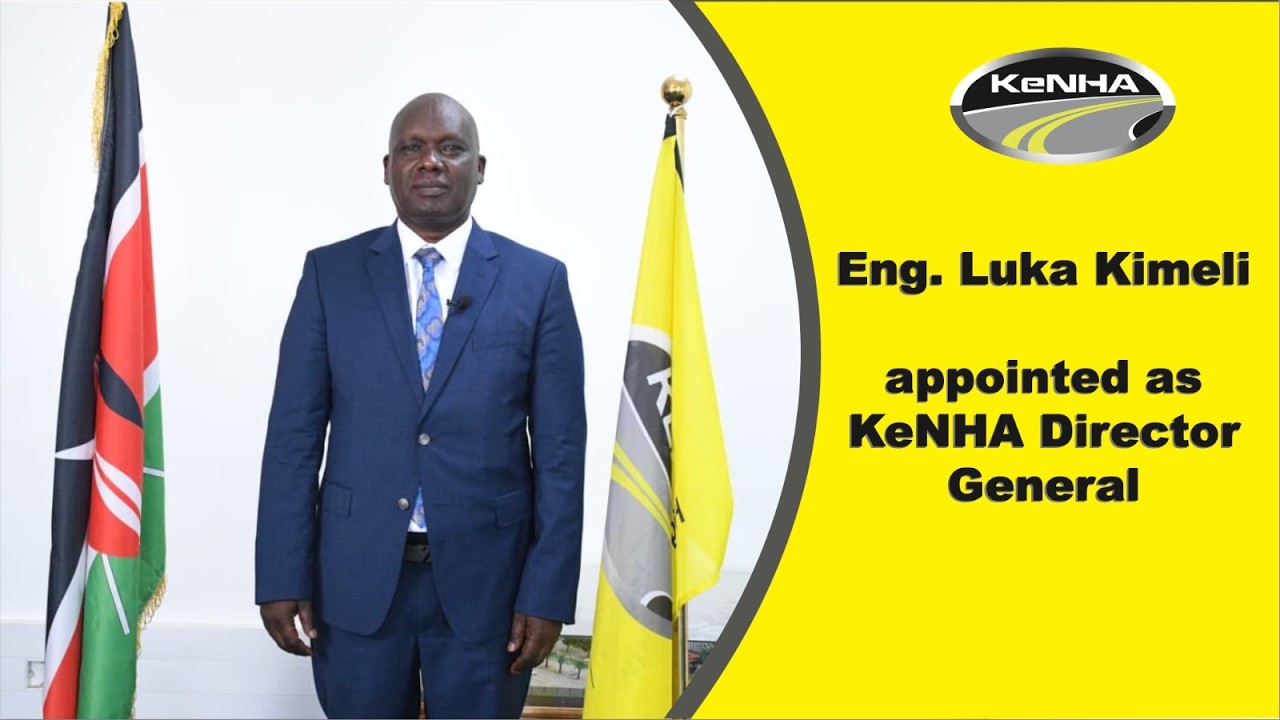
The appointment of Eng. Luka Kipchumba Kimeli as Director-General of the Kenya National Highways Authority (KeNHA) has quickly been overshadowed by serious allegations linking his office to the questionable award of a multi-million-shilling tender to a foreign contractor.
What was initially expected to mark a new chapter in leadership at the agency has instead triggered renewed concerns about procurement integrity, institutional accountability, and governance within one of Kenya’s most critical infrastructure bodies.
Kimeli’s appointment was formalised on February 17, 2026, by the KeNHA Board in consultation with the Ministry of Roads and Transport, following a seven-month acting tenure. The Board described the recruitment process as competitive and transparent. However, that assurance has done little to quiet the growing wave of allegations that began circulating almost immediately after his confirmation.
At the heart of the controversy are claims that Kimeli’s office may have facilitated the award of a lucrative contract to a foreign—reportedly Somali—contractor under circumstances that raise serious questions about due process. The allegations suggest that internal procurement procedures may have been manipulated to favour a predetermined outcome, with procurement officials allegedly working in coordination with contractors for kickbacks.
While these claims have not yet been formally tested before any investigative or judicial body, their timing and nature have amplified public concern. Neither KeNHA nor the Ministry of Roads and Transport has issued a detailed public response, and key oversight institutions have yet to make any definitive pronouncements. This silence has itself become a central issue, raising questions about whether accountability mechanisms are functioning as intended.
The controversy surrounding the alleged tender award is particularly significant given KeNHA’s history. The authority has long faced criticism over procurement irregularities, cost overruns, and weak financial controls. Reports from the Office of the Auditor-General have repeatedly flagged issues such as missing documentation, unexplained project cost variations, unsupported expenditures, and payments made without verifiable records.
These systemic concerns provide a backdrop that makes the current allegations more alarming. If proven, they would not represent an isolated incident but rather a continuation of longstanding institutional weaknesses that have cost taxpayers billions of shillings over the years.
Kimeli’s tenure prior to his confirmation had already attracted legal scrutiny. In November 2025, the High Court found him guilty of contempt of court for failing to comply with an order requiring KeNHA to settle a debt of over KSh 536 million owed to SBI International Holdings. The court rejected his explanation that the delay was due to budgetary constraints, ruling instead that the failure to pay constituted wilful disobedience of a binding order.
This case is part of a broader and costly dispute involving SBI, which has seen the Kenyan government pay over KSh 6 billion in settlements related to contract breaches. The dispute itself exposed deeper issues within KeNHA’s contract management systems, including delayed payments, litigation, and financial mismanagement.
Further questions about procurement practices emerged during Kimeli’s acting tenure in July 2025, when KeNHA issued a controversial tender for the Pangani–Muthaiga–Kiambu road project. The tender restricted eligibility exclusively to Chinese firms or consortia, citing financing arrangements. This move effectively excluded local contractors and was widely criticised as a violation of procurement laws that prioritise Kenyan firms.
In a sudden and unexplained move, KeNHA later revoked the tender without providing clarification. The incident attracted parliamentary attention, with lawmakers questioning the legality and rationale behind the restriction. However, no formal accountability process was concluded, and Kimeli was subsequently confirmed as Director-General without publicly addressing the matter.
These past incidents have intensified scrutiny over the latest allegations. Observers argue that the pattern of unexplained procurement decisions, combined with weak oversight responses, points to deeper structural issues within the agency.
The stakes are particularly high. KeNHA currently manages billions of shillings in public funds allocated to major infrastructure projects. The agency has secured significant financing, including funds for large-scale projects such as the Isiolo–Mandera highway and other national road developments. Decisions made under Kimeli’s leadership will therefore have long-term implications for both infrastructure development and public finance.
The lack of immediate action from oversight bodies such as the Public Procurement Regulatory Authority, the Ethics and Anti-Corruption Commission, and parliamentary committees has become a focal point of concern. Critics argue that failure to act promptly risks normalising impunity and undermining public confidence in governance systems.
Transparency advocates also point out that while KeNHA maintains a public portal for tender awards, such measures are insufficient if the underlying procurement processes are not subject to rigorous scrutiny. Without proper documentation and accountability, transparency tools risk becoming symbolic rather than effective.
The broader governance context further complicates the situation. Recent reports, including those by international bodies such as the OECD, have highlighted systemic weaknesses in Kenya’s procurement systems, including limited enforcement of anti-collusion laws and inadequate coordination among oversight agencies.
These structural challenges create an environment where allegations of irregularities can emerge and persist without timely resolution.
For Kimeli, the pressure is mounting. As the accounting officer of an agency handling vast public resources, he is now at the center of a growing debate about integrity, leadership, and accountability in Kenya’s infrastructure sector. His decision not to publicly address the allegations thus far has only fueled further speculation and criticism.
At the same time, KeNHA leadership has continued with routine activities, including site visits and project inspections, presenting an image of business as usual. However, critics argue that visible activity cannot substitute for accountability, especially when serious questions remain unanswered.
Ultimately, the allegations surrounding the tender award represent more than just a test of one individual’s leadership. They are a test of Kenya’s broader governance systems—whether institutions responsible for oversight will act decisively, or whether the pattern of delayed accountability will continue.
The outcome of this situation will likely shape public perception of not only KeNHA but also the government’s commitment to transparency in managing public resources. For an agency entrusted with billions in infrastructure funding, the need for clarity, accountability, and trust has never been more urgent.