
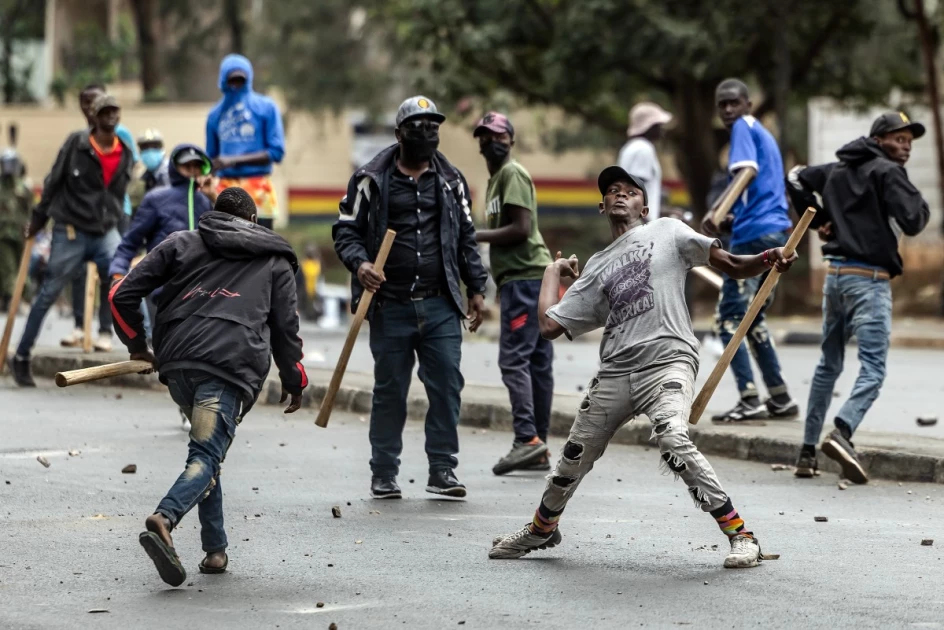
A powerful and deeply provocative argument is emerging in Kenya’s political discourse—challenging the widespread use of the term “goons” to describe politically active youth, particularly from regions historically aligned with opposition politics.
At the center of this debate is a broader question: is the label “goon” a reflection of criminal behavior, or is it a convenient political narrative used to dismiss and delegitimize economically marginalized young people?
The argument traces its roots back to Kenya’s post-independence history, suggesting that entire communities—particularly in Nyanza and Western Kenya—have faced systematic exclusion from state opportunities for decades.
According to this perspective, the marginalization began in the era of Jomo Kenyatta, following a political fallout with Jaramogi Oginga Odinga.
Also Read: Tension after Kisumu Senator Prof. Tom Ojienda Linked to the Kisumu Attack
This split, which led to the formation of the Kenya People’s Union (KPU), reportedly triggered a wave of political repression, including detentions, economic exclusion, and reduced access to state resources for those perceived to be aligned with the opposition.
The situation is said to have deepened under Daniel arap Moi, where dissenting voices—such as Masinde Muliro and Martin Shikuku—faced detention and suppression.
The impact, however, extended beyond individual leaders.
Entire communities found themselves locked out of government jobs, state contracts, and development opportunities, creating a long-term economic imbalance that still shapes Kenya today.
Even during later administrations, including those of Mwai Kibaki and Uhuru Kenyatta, political alignments continued to influence access to state-linked opportunities, reinforcing patterns of inclusion and exclusion.
The result, as argued in the analysis, is visible in Kenya’s labor structure today.
Out of approximately 18 to 19 million employed Kenyans, only about 3 million are in formal employment, while the overwhelming majority—over 15 million—operate within the informal sector, commonly referred to as the jua kali economy.
This informal sector includes everyday workers: boda boda riders, mechanics, fundis, small-scale traders, and young graduates navigating survival without stable employment or social protections.
The argument challenges the logic of labeling politically active youth as “goons,” pointing out that by that definition, the majority of Kenya’s workforce would fall into the same category.
It further suggests that political engagement among youth in marginalized regions is not accidental but rather a direct response to economic exclusion.
When formal employment opportunities are limited and access to state resources is uneven, politics becomes one of the few remaining avenues for visibility, influence, and potential economic mobility.
The analysis also highlights what it describes as a double standard in political narratives.
Young people working in political campaigns—organizing rallies, managing logistics, handling digital communications—are often praised when aligned with certain leaders but dismissed as “goons” when associated with others.
This selective labeling, critics argue, serves to delegitimize certain political voices while normalizing others.
Importantly, the discussion does not deny the existence of criminal elements within political mobilization but calls for a more nuanced understanding that separates genuine criminality from economic desperation and political participation.
It raises fundamental questions about Kenya’s economic structure:
Why does the system produce hundreds of thousands of graduates annually while creating only a fraction of formal jobs?
Why are certain regions disproportionately represented in informal sectors?
And what structural changes are needed to bridge this gap?
At its core, the argument reframes the conversation from one of blame to one of systemic failure.
Rather than focusing solely on individuals labeled as “goons,” it points to deeper issues—unemployment, inequality, historical marginalization, and limited access to opportunity—as the real drivers of the phenomenon.
The debate is likely to intensify as Kenya continues to grapple with youth unemployment, political polarization, and economic inequality.
For policymakers, it presents a challenge to rethink how the informal sector is integrated into the national economy and how young people can be meaningfully included in both economic and political systems.
For the public, it raises a critical question:
Are “goons” a product of individual choices—or a reflection of a system that has left millions with limited alternatives?