
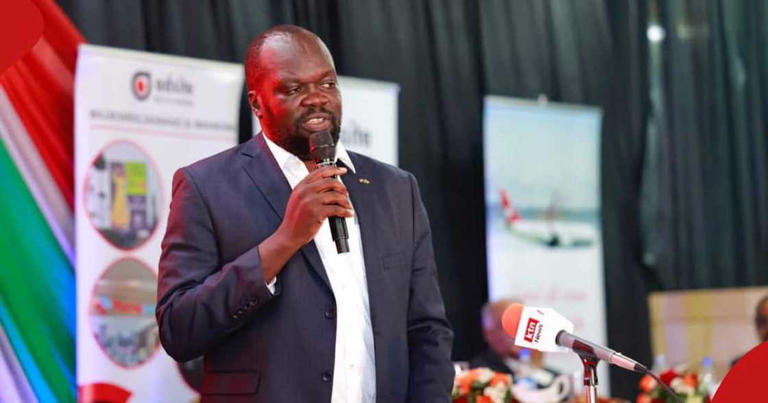
Robert Alai has ignited a fresh legal and political debate after strongly condemning what he describes as “trial by public opinion” in the ongoing case involving the attack on Godfrey Osotsi.
In a sharply worded statement, Alai made it clear that while he fully condemns the violence against Senator Osotsi and wishes him a quick recovery, he will not support what he termed as “kangaroo courts” targeting the accused suspects.
He warned that the case is already being shaped outside the courtroom, with suspects allegedly judged and condemned through social media, political commentary, and ethnic narratives before due process is followed.
Also Read: Robert Alai Blasts ODM Leadership Over Communication Breakdown, Warns Party Risks Collapse
According to Alai, critical investigative steps are yet to be completed, raising concerns about the rush to conclusions.
He pointed to gaps in the case, including the absence of a recorded complainant’s statement, lack of an identification parade, and pending analysis of CCTV footage and mobile phone data.
He also noted that other suspects linked to the incident are still at large, suggesting that investigations are far from complete.
Despite this, Alai argued that politicians and sections of the public have already branded the accused as criminals, using terms like “goons” and “animals,” which he says undermines the integrity of the justice process.
He warned that such language, especially when mixed with ethnic undertones, risks fueling division and incitement in an already sensitive political environment.
At the heart of his argument is the constitutional principle of presumption of innocence, as provided under Article 50 of the Constitution of Kenya.
Alai emphasised that every accused person is entitled to a fair trial based on evidence presented in court, not a judgment passed in public forums or media platforms.
He cautioned that allowing public sentiment to dictate legal outcomes sets a dangerous precedent, where accusations alone become sufficient for conviction.
Beyond the legal concerns, Alai expanded the conversation to address deeper socio-economic issues.
He argued that the labelling of young people as “goons” ignores the broader reality facing millions of Kenyan youth, particularly those in the informal sector.
Citing figures of over 15 million young Kenyans operating without stable employment or protection, he described the situation as a ticking social and economic crisis.
According to him, political leaders should focus on addressing unemployment and economic exclusion rather than using inflammatory language that stigmatises vulnerable groups.
He framed the issue as one of systemic failure, where lack of opportunities pushes some youth into desperate situations, only for them to be collectively branded as criminals.
Alai also positioned himself as a representative of struggling youth, particularly in Dagoretti North, stating that he would not remain silent as young people are “blanket-labelled” and subjected to what he views as politically motivated narratives.
He called out what he described as ethnic profiling disguised as outrage, warning that such rhetoric could deepen divisions and escalate tensions.
In his message to the families of the accused, Alai offered reassurance, stating that their sons deserve justice through lawful processes—not mob justice or public condemnation.
He urged fellow leaders to move away from “soundbites” and instead present concrete solutions to the challenges facing young people in the country.
To the public, his message was equally direct: allow the law to take its course and avoid rushing to judgment.
The statement adds a new dimension to the Osotsi attack case, shifting part of the focus from the incident itself to how justice is pursued and perceived.
It also reflects the broader national conversation around justice, youth unemployment, political rhetoric, and the role of public opinion in high-profile cases.
STOP THE KANGAROO COURTS ON THE OSOTSI ATTACK
I condemn in the strongest terms the attack on Senator Godfrey Osotsi. Political violence has no place in our democracy. I wish him a full recovery.
But I will not be silent as three young men are tried and convicted on social… pic.twitter.com/Eoj9oQYOme
— Robert ALAI, HSC (@RobertAlai) April 11, 2026
As investigations continue, the tension between legal process and public perception is likely to remain a central issue, with voices like Robert Alai pushing for restraint, due process, and a deeper examination of the root causes behind such incidents.